

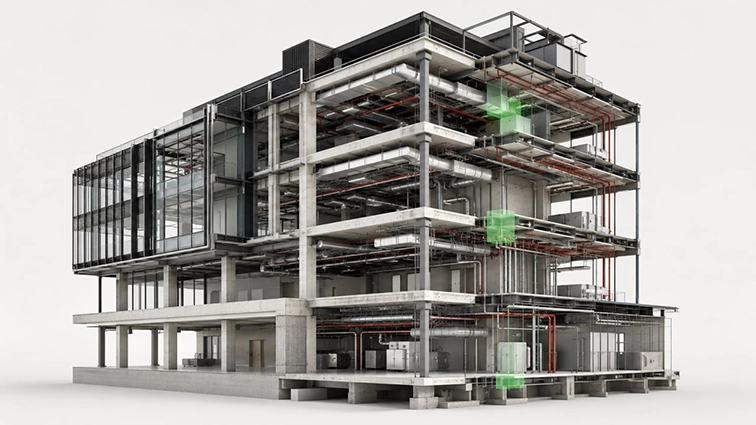
Building projects are becoming increasingly complex. Architects, structural engineers, building-services consultants, contractors and specialist trades often develop their designs using separate models and documentation. Although each discipline may produce an accurate design independently, conflicts can emerge when these elements are brought together.
BIM coordination provides a structured way to identify and resolve these issues before they reach the construction site.
What Is BIM Coordination?
BIM coordination is the process of combining architectural, structural and building-services models within a shared digital environment. The coordinated model allows project teams to review how different systems interact and identify design conflicts, missing information and constructability concerns.
This process may include:
- Reviewing model alignment and project coordinates
- Combining discipline models into a federated model
- Running clash-detection tests
- Checking spatial clearances and access requirements
- Assigning issues to responsible team members
- Monitoring issue resolution
- Confirming that approved changes are reflected across the project documentation
BIM coordination is not simply an automated clash-detection exercise. Software can identify where modelled elements overlap, but experienced review is still required to determine which issues are important, understand their construction impact and recommend practical solutions.
Finding Problems Before They Reach the Site
A design may appear coordinated when individual drawings are reviewed separately. However, combining the models can reveal issues that are difficult to identify through traditional two-dimensional documentation.
Common coordination issues include:
- Mechanical ductwork passing through structural beams
- Hydraulic services conflicting with foundations or transfer structures
- Cable trays occupying the same space as fire-protection systems
- Insufficient ceiling space for coordinated building services
- Penetrations missing from structural elements
- Doors, equipment or access panels without adequate operating clearance
- Architectural finishes reducing required installation space
- Inconsistent levels, grids or project coordinates
- Differences between the model and issued drawings
When these problems are discovered during construction, they can lead to requests for information, redesign, delays, rework and unplanned costs. Identifying them digitally gives the project team more time to evaluate the options and agree on a solution.
More Than Clash Detection
Not every geometric clash represents a genuine construction problem, and not every project risk appears as a physical clash.
For example, two objects may overlap because of modelling conventions rather than an actual design conflict. Conversely, mechanical equipment may fit within a plantroom without technically clashing but still lack sufficient clearance for installation, operation or future maintenance.
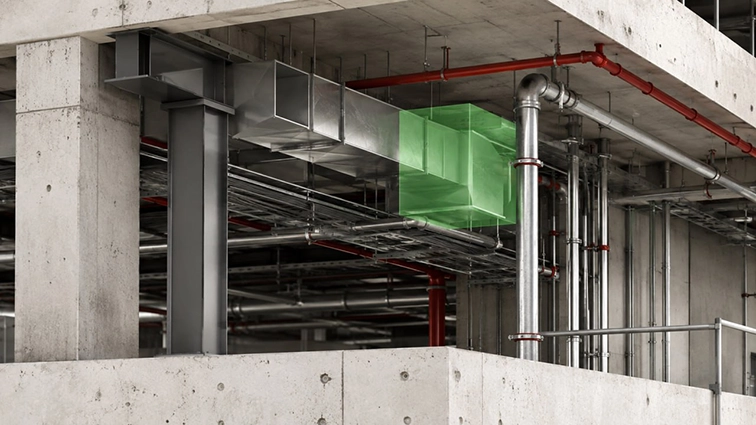
Effective BIM coordination therefore considers:
Spatial Coordination
Do the architectural, structural and building-services elements fit together within the available space?
Constructability
Can the proposed design be built safely and in a practical sequence?
Access and Maintenance
Can equipment be installed, inspected, repaired and replaced throughout the building’s operational life?
Model Consistency
Are levels, grids, coordinates, openings and key design elements consistent across all discipline models?
Information Quality
Does the model contain the appropriate information for the current project stage and its intended use?
This broader approach turns BIM coordination into a design-management process rather than a software-generated clash report.
A Practical BIM Coordination Workflow
A successful coordination process begins with clearly defined requirements and responsibilities.
- Establish the Project Requirements
The BIM Execution Plan should define the required models, file formats, model-sharing frequency, naming conventions, project coordinates, responsibilities and coordination procedures.
- Review the Discipline Models
Before coordination begins, each model should be checked for correct positioning, suitable model detail and basic compliance with the agreed project standards.
- Create the Federated Model
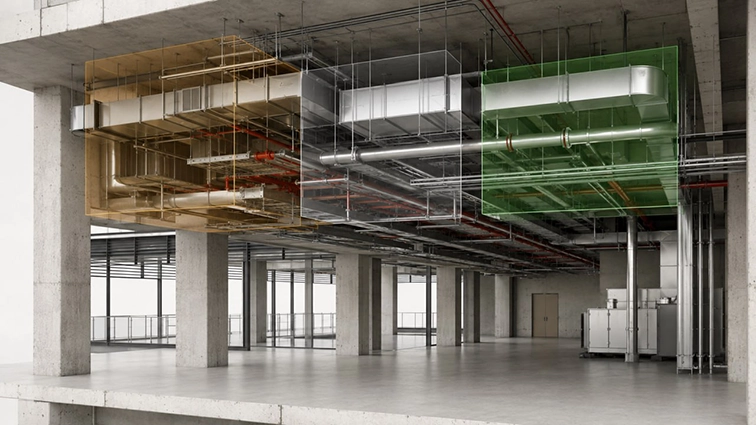
The architectural, structural and building-services models are combined without altering the original discipline files. This provides a consolidated view of the project.
- Run Targeted Clash Tests
Clash tests should focus on meaningful relationships, such as services against structure or ceiling services within constrained zones. Carefully planned tests produce more useful results than running every model element against everything else.
- Review and Prioritise Issues
Detected conflicts should be assessed to remove duplicates and irrelevant results. Genuine issues can then be prioritised according to their severity, programme impact and required resolution date.
- Assign and Track Actions
Each coordination issue should have a clear description, model location, responsible party, required action and due date. Issues can then be reviewed during coordination meetings and tracked until closure.
- Verify the Resolution
An issue should not be closed solely because a response has been provided. The updated models must be reviewed to confirm that the conflict has been resolved without creating another problem elsewhere.
Common Coordination Mistakes
Several recurring problems can reduce the value of BIM coordination:
- Starting coordination after major design decisions have already been finalised
- Using outdated or incorrectly positioned models
- Producing hundreds of unfiltered clash results
- Assigning issues without clear responsibility or deadlines
- Focusing only on physical clashes
- Closing issues before verifying updated models
- Failing to reflect coordinated changes in drawings and schedules
- Treating coordination meetings as reporting sessions rather than decision-making sessions
The purpose of coordination is not to produce the largest possible clash report. The objective is to provide the project team with accurate, prioritised and actionable information.
The Value of Early Coordination
BIM coordination delivers its greatest value when it begins early and continues throughout design development and construction documentation.
Early coordination allows the team to resolve fundamental spatial issues while the design remains flexible. As the project develops, the process can become progressively more detailed, supporting service routing, structural penetrations, ceiling coordination, equipment access and construction sequencing.
A coordinated digital model can support:
- More informed design decisions
- Better communication between disciplines
- Reduced rework and disruption
- More reliable drawings and schedules
- Earlier identification of constructability risks
- Clearer responsibility for issue resolution
- Greater confidence before construction begins
Turning Models into Better Project Outcomes
The value of BIM does not come from creating a three-dimensional model alone. It comes from using coordinated information to make better decisions.
Effective BIM coordination connects people, processes and technology. It provides a shared understanding of the design, makes complex issues easier to communicate and gives project teams an opportunity to resolve problems when changes are still manageable.
By identifying conflicts before construction begins, BIM coordination helps transform project models into practical tools for reducing risk and improving delivery.
How 6DBIM Can Help
6DBIM provides BIM coordination and digital engineering support across architectural, structural and building-services disciplines.
Our services can include:
- Model federation and coordination reviews
- Clash detection and constructability assessment
- Coordination issue reporting and tracking
- BIM model audits
- Revit and Navisworks coordination
- BIM Execution Plan development
- Common Data Environment workflow support
- Multidisciplinary model and documentation reviews
Our approach focuses on clear, practical and actionable coordination—helping project teams identify risks earlier and move into construction with greater confidence.
Discuss your project with 6DBIM to establish a practical BIM coordination strategy tailored to your team, project stage and delivery requirements.